Bicep Femoris Muscle: The Best Trainer’s Complete Guide to Targeted Hamstring Development
Ask most personal trainers to describe how they specifically target it — distinct from the rest of the hamstring group — and the answer is often surprisingly vague. That gap between anatomical knowledge and applied programming is precisely where injury risk hides and performance plateaus are born. This guide is a practical reference for coaches who want to close that gap: a focused breakdown of the most effective bicep femoris muscle exercises, the anatomical rationale behind each one, and a framework for integrating bicep femoris strengthening exercises into real-world client programmes with intention and precision.
Key Takeaways
- The bicep femoris is structurally unique among the hamstrings — its two heads have different origins, meaning no single exercise fully loads both without deliberate programming.
- Targeting only hip extension misses the short head entirely; effective programming must include dedicated knee flexion work to train the full muscle.
- The Nordic hamstring curl produces the highest eccentric demand of any hamstring exercise and is backed by the strongest injury-prevention evidence in the literature — yet it features in fewer than 20% of general fitness programmes.
- Tibial rotation during leg curl variations is a legitimate coaching lever: external rotation selectively increases bicep femoris activation over the medial hamstrings.
- Chronic quad dominance in typical gym programming is one of the most consistent predictors of hamstring vulnerability — redressing that balance is a duty of care, not just an aesthetic consideration.
There’s a particular kind of frustration that surfaces in training logs around the six-month mark. Squats are progressing. Leg press numbers are climbing. And yet the posterior chain — specifically the lateral hamstrings — remains stubbornly underdeveloped, and niggling tightness behind the knee keeps coming and going. The culprit is almost always the same: the programme has been training “hamstrings” as a category rather than the bicep femoris as a specific anatomical structure with its own functional demands.
It’s an understandable oversight. The fitness industry has long defaulted to broad muscle-group language — quads, hamstrings, glutes — that obscures the architectural complexity underneath. But the bicep femoris doesn’t share the same origin, the same mechanical role, or the same injury profile as the semitendinosus or semimembranosus. Treating it as interchangeable with its medial neighbours is a bit like training the long head of the triceps with exclusively elbow extension work and wondering why the muscle looks flat from certain angles.
What follows is a coach-first resource: anatomy that informs exercise selection, exercise explanations that go beyond technique cues, and a programming framework grounded in what the research actually supports.
Bicep Femoris Anatomy: What Every Trainer Needs to Understand Before Prescribing an Exercise
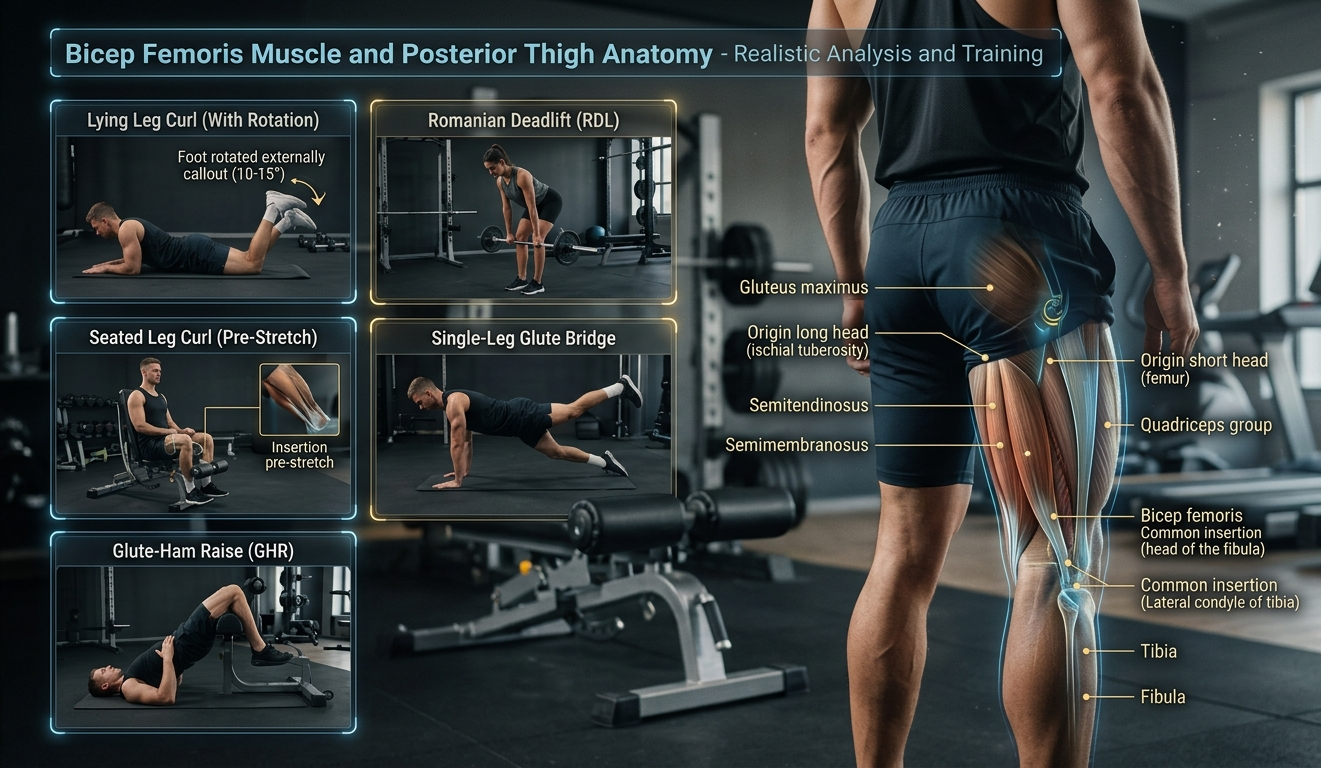
The bicep femoris gets its name from its two-headed structure — bicep meaning two, femoris referring to the femur — but the significance of that dual architecture goes well beyond a naming convention. The two heads originate from entirely different locations on the skeleton, which means they don’t just share a common insertion; in many respects, they behave as functionally separate muscles that happen to converge at the fibular head.
| Structure | Origin | Insertion | Primary Function |
|---|---|---|---|
| Long Head | Ischial tuberosity (shared with semitendinosus) | Head of the fibula, lateral condyle of the tibia | Hip extension, knee flexion, external tibial rotation |
| Short Head | Lateral lip of the linea aspera (posterior femur) | Head of the fibula | Knee flexion only; does not cross the hip |
The practical consequence of this anatomy is significant. Because the long head spans the hip and knee, it requires loading across both joints to be recruited fully. An exercise that only involves hip extension — a cable pull-through, for instance — will challenge the long head, but it won’t ask it to work isometrically across a flexed knee simultaneously. Conversely, a leg curl that only involves knee flexion reaches the short head, which has no connection to the hip whatsoever and cannot be trained through hip hinge patterns at all. Most general fitness programmes do one or the other. Rarely both. Almost never in a deliberate ratio that reflects what the muscle actually needs.
Among all three hamstring muscles, the bicep femoris long head is statistically the most frequent site of acute strain injury in sport — accounting for the majority of hamstring tears seen in sprinting and high-velocity kicking activities. The reason is mechanical: as a biarticular muscle, it faces simultaneous eccentric demands at the hip and knee during the late swing phase of running, stretching it across two joints at once. This makes building eccentric tolerance in the long head not merely a performance priority but a clinical one — and it shapes which exercises deserve priority in any injury-resilient programme.
Worth adding to that picture is the bicep femoris’s role as a lateral tibial rotator. When the knee is flexed, the bicep femoris externally rotates the lower leg — a function that contributes to knee joint stability during dynamic movements like pivoting, cutting, and landing. Athletes in team sports, racquet sports, or any discipline involving rapid directional changes have a particular stake in developing this capacity. It’s rarely trained explicitly, but the coaching opportunity is real.
The Five Best Bicep Femoris Exercises — Chosen for Mechanism, Not Popularity
The exercises below weren’t selected because they appear on every “best hamstring exercises” list. They were selected because each one addresses a specific mechanical demand of the bicep femoris that the others don’t fully cover. Where relevant, the distinction between long head and short head recruitment is explained, because that distinction is what makes the difference between a programme that looks complete and one that actually is.
Nordic Hamstring Curl (Eccentric)
No exercise in the hamstring category carries a stronger evidence base for injury prevention than the Nordic curl — and yet it remains conspicuously absent from the majority of gym programmes. The volume of research supporting its inclusion is now substantial enough that omitting it, particularly with athletic or active clients, is difficult to justify on clinical grounds. Injury incidence reductions of 50% or greater have been documented in team sport settings, making it one of the most cost-effective interventions available to coaches working with at-risk populations.
From a mechanical standpoint, the Nordic curl forces the bicep femoris long head to decelerate the body under extreme eccentric load, at a lengthened position, while the knee extends. That combination — high tension, long length, eccentric contraction — mirrors almost exactly the conditions during late swing phase in sprinting, when the vast majority of hamstring tears occur. Programming this exercise isn’t just about building strength; it’s about building tolerance for the specific stress profile that causes injuries.
Romanian Deadlift (RDL)
The Romanian deadlift earns its place in every posterior chain programme not because it’s fashionable, but because it effectively targets the bicep femoris muscle and strengthens the entire back side of the body., but because the mechanical stimulus it delivers is genuinely hard to replicate. By keeping the knees relatively extended while hinging forward, the RDL places the bicep femoris long head under progressive stretch — increasing tension at the very end range where the distal musculotendinous junction is most vulnerable to injury. Training that vulnerability directly is how you bulletproof it.
One technique variable worth communicating to more experienced clients: a slightly wider stance with a degree of external hip rotation tends to shift the loading emphasis toward the lateral hamstrings, making it a subtly more bicep-femoris-targeted pattern. It’s not a dramatic change, but for clients trying to address a specific imbalance, these kinds of small adjustments compound over a training block into measurable differences.
Lying Leg Curl — Externally Rotated Foot Position
The lying leg curl is often dismissed as a machine-based isolation exercise with limited transfer value. That criticism has some merit when the exercise is performed without thought — but apply one specific technique modification and it becomes one of the most targeted bicep femoris tools available. Because the bicep femoris functions as an external tibial rotator, positioning the foot in slight external rotation before initiating the curl increases the degree to which the lateral hamstring is recruited relative to the semimembranosus and semitendinosus. The movement doesn’t change; the muscle emphasis shifts considerably.
This variation also serves a function no hip hinge exercise can: it directly challenges the bicep femoris short head, which has no hip attachment and therefore never contributes to deadlift or RDL patterns. Clients who plateau on hip hinge strength despite consistent programming often have an underdeveloped short head — an issue that only knee flexion–based exercise can address.
Single-Leg Romanian Deadlift (B-Stance or Fully Unilateral)
Bilateral exercises build bilateral strength. What they don’t build — and this is a distinction that matters more as clients get stronger and more active — is the ability to stabilise the knee and hip under load on a single limb. The single-leg RDL forces the bicep femoris muscle into a dual role: it must simultaneously produce the hip extension force driving the movement and maintain lateral knee stability against the ground reaction forces the movement generates. That combined demand is far closer to what the muscle faces during running, stair descent, or single-leg landing than any barbell pattern performed with two feet on the floor.
Beyond that, the single-leg RDL functions as an honest assessment of left-to-right asymmetry. The bilateral RDL can mask significant imbalances — the dominant side quietly compensates while the deficient side, including weaknesses in the bicep femoris muscle, is never truly challenged. Switch to unilateral loading and those asymmetries become visible immediately. Identifying them is step one; addressing them through consistent unilateral programming is what actually resolves them..
Glute-Ham Raise
The glute-ham raise is probably the most technically demanding exercise on this list, and also the most complete from a bicep femoris muscle standpoint. Where other exercises ask the muscle to do one thing at a time — either extend the hip or flex the knee — the glute-ham raise asks it to do both, sequentially and under load, through a full range of motion.That continuity of demand — transitioning from an eccentric knee extension phase into a concentric hip extension finish — produces a stimulus for the bicep femoris muscle that no isolated exercise can replicate.
The obstacle for most trainers isn’t understanding why it works — it’s knowing how to introduce it sensibly. Clients who attempt a full glute-ham raise without adequate eccentric bicep femoris muscle strength will simply collapse at the knees in the first phase, deriving no benefit and risking frustration. The solution is a structured regression: begin with partial range eccentrics, progress to full eccentric with hand assistance on the return, and reach unassisted full reps only once the bicep femoris muscle can genuinely control the descent. That progression typically takes four to eight weeks and is worth every session of it.
Five Programming Errors That Undermine Bicep Femoris Development
Technical errors in exercise execution get a lot of attention in coaching education. Programming errors — the structural decisions made before a single rep is performed — tend to get far less. These are the mistakes worth examining.
-
✗Using “hamstrings” as the unit of programming. The medial hamstrings (semitendinosus, semimembranosus) and the bicep femoris have different origins, different dominant functions, and different injury profiles. A programme designed around “hamstring exercises” will produce hamstring development, but not necessarily bicep femoris development. Once a coach starts thinking in terms of the individual muscles — and what each one specifically needs — the exercise selection and rationale changes completely.
-
✗Writing the short head out of the programme. It seems counterintuitive, but it’s possible to train the hamstrings heavily for months and barely touch the bicep femoris short head — because the short head is a single-joint muscle that only activates during knee flexion. It contributes nothing to hip extension and therefore doesn’t appear in any deadlift variation. Programmes that consist entirely of hip hinge patterns, however well-executed, have a structural gap that only knee flexion work can close.
-
✗Concentrating hamstring volume at short muscle lengths. When a leg curl follows a set of deadlifts at the end of a session, the hamstrings are already fatigued from a long-length stimulus, and the curl is now loading them in a shortened position. That’s not necessarily a problem — but if it’s the only kind of hamstring work in the programme, research on muscle length and hypertrophy suggests the client is leaving adaptation on the table. The evidence consistently supports training at longer lengths for superior growth; exercises that stretch the hamstring under load, like the RDL or Nordic curl, should feature prominently rather than as an afterthought.
-
✗Treating foot position as cosmetic. The orientation of the foot during leg curl variations has a direct and measurable effect on which portion of the hamstring group is emphasised. This isn’t a minor nuance — it’s the difference between a general hamstring exercise and a laterally targeted bicep femoris exercise performed on the same machine. Coaches who haven’t incorporated foot rotation as a deliberate variable are effectively using a precision tool without its finest setting.
-
✗Allowing the quad-to-hamstring volume imbalance to persist. In a typical resistance training programme structured around squats, leg press, and lunges, the quadriceps receive substantially more direct loading than the hamstrings. That imbalance isn’t inherently dangerous in the short term, but across a training career it tends to manifest as knee tracking issues, reduced force absorption capacity, and heightened susceptibility to hamstring strain. A hamstring-to-quadriceps strength ratio at the knee of approximately 0.6:1 is widely used as a benchmark in rehabilitation and sports science settings; helping clients approach that benchmark through deliberate posterior chain programming is sound professional practice.
How to Programme Bicep Femoris Exercises: A Phase-Based Framework
The table below is a working template, not a fixed prescription. Its design logic is straightforward: establish the movement quality and baseline tissue tolerance in the early weeks, introduce more specific and demanding stimuli once those foundations are in place, and build toward the exercises — Nordic curls, glute-ham raises, heavy unilateral patterns — that deliver the greatest long-term adaptation. Adjust volume and intensity to reflect the client’s training history, any previous hamstring injury, and recovery capacity.
| Training Phase | Primary Focus | Recommended Exercises | Volume |
|---|---|---|---|
| Weeks 1–3 Foundation |
Hip hinge mechanics, tissue conditioning | B-stance RDL, lying leg curl (neutral foot) | 3×10–12 each |
| Weeks 4–6 Development |
Long-head loading, introduce eccentric work | Bilateral RDL, leg curl (external rotation), Nordic introductory reps | 3–4×8–10 |
| Weeks 7–10 Intensification |
Strength, eccentric capacity, unilateral | Single-leg RDL, Nordic curls (progressively), glute-ham raise | 4×6–8, Nordic: 3×5 |
| Maintenance Ongoing |
Maintain strength balance, injury resilience | Rotate exercises; maintain ≥1 Nordic/eccentric session per week | 2–3 sessions/week total posterior chain |
A word specifically on the transition to Nordic curls: the soreness response in untrained individuals is pronounced and prolonged. Clients who perform their first full Nordic session often experience significant delayed-onset muscle soreness for three to five days — not because the exercise is harmful, but because it generates a degree of eccentric mechanical stress that the tissue has not previously encountered. Communicating this in advance preserves the training relationship. Introducing two to three reps at the end of a session, rather than a full three-set block, is a pragmatic way to begin the adaptation process without creating an experience that puts clients off the exercise entirely.
Closing Thoughts: Specificity Is the Standard
The bicep femoris is not a difficult muscle to train. It responds to load, eccentric stress, and progressive overload like any other. What makes it challenging is the tendency — in both programming and professional education — to subsume it within a broader category that doesn’t reflect its actual anatomy or functional demands. The short head is invisible to hip hinge work. The long head needs eccentric loading at length, not just concentric contractions through a partial range. The external tibial rotation function is almost never addressed at all.
Closing those gaps requires specificity: choosing exercises that target the right head, the right function, and the right mechanical demand for each client at each stage of their training. That’s what the exercises and framework in this guide are designed to support. Not more hamstring volume — more precise hamstring volume.
The trainers who grasp this distinction — and who apply it consistently in their programming — will find it shows up in client outcomes that are hard to attribute to any single session but accumulate noticeably over a block: fewer soft-tissue complaints, more balanced posterior chain development, and a capacity for lower-body loading that holds up under the kind of training demands that eventually expose structural weaknesses in less considered programmes.
References & Further Reading
- Petersen J, et al. — “Preventive effect of eccentric training on acute hamstring injuries in men’s soccer” (2011)American Journal of Sports Medicine · Foundational RCT on Nordic curl injury prevention, reporting ~50% reduction in hamstring strain incidence.
- van Dyk N, et al. — “Including the Nordic Hamstring exercise in injury prevention programmes halves the rate of hamstring injuries” (2019)British Journal of Sports Medicine · Meta-analysis of 8 RCTs confirming eccentric hamstring training as the most effective injury prevention strategy.
- Schoenfeld BJ & Grgic J — “Effects of range of motion on muscle development during resistance training interventions” (2020)Journal of Strength and Conditioning Research · Evidence that training at longer muscle lengths produces superior hypertrophic adaptations.
- NSCA — “Hamstring Muscle Group: Anatomy, Exercises, and Injury Prevention”National Strength and Conditioning Association · Practical review of hamstring anatomy and programming principles for S&C coaches.
- Physiopedia — “Biceps Femoris” Anatomy ReferencePhysiopedia · Comprehensive anatomical overview including origin, insertion, innervation, and clinical relevance of both heads.
- Pas HIMFL, et al. — “Hamstring muscle injuries, a rehabilitation protocol purpose” (2019)Journal of Strength and Conditioning Research · Systematic review of hamstring strain mechanisms and rehabilitation progressions relevant to personal trainers.
How Do You Programme the Bicep Femoris?
Do your clients’ programmes already distinguish between lateral and medial hamstring training? Have you found specific cues or progressions that work particularly well for the Nordic curl or glute-ham raise? Share your experience below — the most useful coaching insights often come from practitioners working on the floor, not from the literature.
Join the DiscussionFound this guide useful? Pass it on to a colleague who’s ready to take their posterior chain programming to the next level.