Adductor Muscle Exercises: Stop Suffering, Best Rebuilding With a Proven Rehab Blueprint
🦵Adductor muscle exercises are the cornerstone of recovering from a groin strain, hip adductor tear, or chronic inner-thigh tightness. Whether you’re an athlete returning to sport or simply want to move without pain, the right sequence of adductor strengthening and stretching exercises makes the difference between a full recovery and a frustrating cycle of re-injury. This guide covers every phase — from gentle isometric activation in week one, through progressive loading, all the way to sport-specific power drills. For a clinical overview of groin anatomy and injury classification, see the Physiopedia groin strain reference. Ready? Let’s get you back on your feet.
Picture this: you push off sharply — a sprint, a lunge, a tackle — and somewhere in your inner thigh you feel it. That familiar, nauseating pull. Suddenly, walking feels odd. Getting out of bed requires a plan. And your workout routine? On hold indefinitely.
If you’ve been through a groin strain or hip adductor injury, you know exactly how frustrating that feeling is. You’re not sidelined because you were reckless — these muscles work hard, they fatigue, and sometimes they just give way. The good news? Adductor injuries heal well. The not-so-good news? Most people rush them, skip phases, and end up right back where they started.
This guide is here to change that. Whether you’re in day one of an acute strain or weeks into a stubborn chronic groin issue, I want to walk you through a progressive, evidence-informed plan that respects where you are — and gets you back to full function, properly.
First Things First: What Exactly Are the Adductors?
Your adductor muscle group sits on the inside of your thigh, running from your pelvis down to your femur (and in some cases, all the way to your knee). There are five muscles in the group — the adductor magnus, longus, brevis, gracilis, and pectineus — but for most people, the adductor longus is the one that gets strained. It’s the longest muscle in the group, responsible for both pulling the leg inward and assisting with hip rotation, which makes it vulnerable when you change direction quickly.
Collectively, these muscles do more than most people realise. They stabilise your pelvis when you walk, help power your running stride, and play a major role in side-to-side movements. This is why a groin strain doesn’t just hurt during sport — it can make ordinary things like climbing stairs or rolling over in bed genuinely painful.
Here’s a useful mental image: imagine squeezing a football between your thighs. That’s your adductors doing their job. Now imagine trying to do that when one of those muscles is partially torn. You get the idea.
🔗 Further Reading — Anatomy & Injury Science
- Physiopedia: Groin Strain Overview — detailed clinical anatomy, mechanism of injury, and differential diagnosis
- StatPearls / NCBI: Hip Adductor Strains — peer-reviewed medical reference covering pathophysiology and management
- NHS: Groin Strain — Simple Guide to Symptoms and Treatment from the UK National Health Service
Know Your Grade Before You Start Exercising
This is something I cannot stress enough: not all adductor strains are equal, and the exercises appropriate for a Grade 1 strain could seriously aggravate a Grade 2 or 3. If you’re unsure of your injury severity, please get a proper assessment from a physiotherapist before loading these muscles.
Minor muscle fibre tears
Some soreness and stiffness, but you can still walk normally. You might notice tightness in the inner thigh with no major loss of strength.
Recovery: typically 2–4 weeks with appropriate rehab.
Partial muscle tear
More significant pain and weakness. Walking may be affected. There’s usually visible bruising and tenderness to the touch along the inner thigh.
Recovery: 4–8 weeks, sometimes longer if return to sport is too rushed.
Complete muscle rupture
Intense pain and significant loss of function. This is relatively rare but requires medical evaluation — and sometimes surgical consultation.
Recovery: 3–6+ months, with professional physiotherapy essential.
Golden rule: No exercise should increase your pain during or after the session. If it does, you’ve either progressed too fast or you’re doing it wrong. Back off, rest for a day, and try the previous phase again. Progress in rehab is rarely linear — and that’s completely normal.
Phase 1: The Gentle Activation Phase (Weeks 1–2)
I know what you’re thinking — “I just want to get moving.” I get it. But here’s the thing: the first phase of adductor rehab isn’t about movement, it’s about controlled tissue healing and pain-free activation. Think of it like laying foundations before you build walls.
During this phase, the goal is simple: reduce inflammation, get blood flow to the area, and start gently reminding those muscle fibres that they exist. You’re not training for anything yet. You’re healing.
Phase 1 Exercises
Adductor Ball Squeeze (Isometric)
Lying on your back with knees bent, place a small ball (or folded pillow) between your knees. Gently squeeze — just below your pain threshold — and hold for 10–30 seconds.
Sets/reps: 3 × 10 reps, 10-second holds. Three times per week.
Supine Butterfly Stretch
Lie on your back, bend both knees, and gently let them fall open to the sides with the soles of your feet touching. Do not push the knees down forcefully. Let gravity do the work.
Hold up to 30 seconds. Repeat 3 times. Comfortable mild tension only.
Seated Hip Rotation
Sit in a chair with feet flat on the floor. Slowly rotate each knee inward and outward in a controlled arc — keeping movement gentle and completely pain-free.
10 slow rotations each direction, twice daily.
“Passive range-of-motion exercises are initiated when the patient can perform them without pain. Active muscle exercises advance slowly from isometric contractions — with no resistance — before progressing to dynamic movement.” — Medscape Sports Medicine, Adductor Strain Rehabilitation Guidelines
Phase 2: Progressive Strengthening (Weeks 3–6)
This is where the real work begins — and where a lot of people either get it right or undo their progress. Phase 2 introduces dynamic loading, which means your muscles are now moving against resistance. The key word, though, is progressive. You don’t go from zero to lateral lunges overnight.
You’re looking for two sensations: effort (the muscle is working) and zero pain (you’re not aggravating the injury). If you’re feeling sharp discomfort rather than muscular fatigue, that’s your body telling you something important. Listen to it.
Phase 2 Exercises
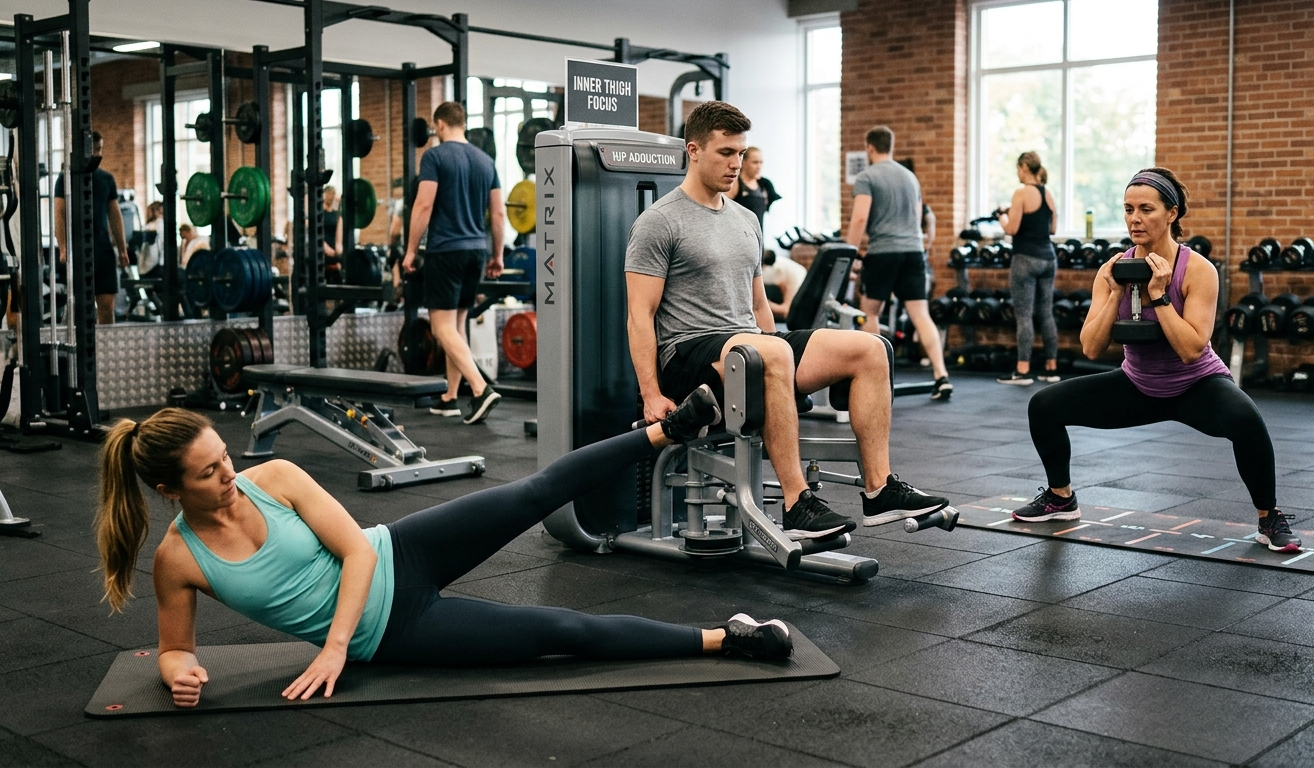
Side-Lying Hip Adduction
Lie on your side with the injured leg on the bottom and the top leg bent for support. Lift the bottom leg upward slowly, pause at the top, lower with control. This is your foundation exercise.
5 sets × 10 reps. Slow and controlled — 3 seconds up, 3 seconds down.
Single-Leg Balance
Stand on the uninjured leg, then on the injured leg as tolerated. Progress to eyes closed or standing on a folded towel to challenge stability. This rebuilds neuromuscular control — often the most overlooked part of groin rehab.
3 × 30-second holds each side.
Lateral Lunge
Stand with feet together. Step wide to one side, bending that knee while keeping the other leg straight. This is a superb dynamic stretch and strength exercise combined — but only introduce it once Phase 1 is fully pain-free.
3 × 8–10 reps each side. Don’t rush the width — earn it over weeks.
Copenhagen Adductor Exercise (Modified)
The most researched adductor strengthening exercise in existence. In its modified form: lie on your side with your top foot resting on a bench or low surface. Lift your bottom leg to meet the top leg, then slowly lower. The lowering phase is where the eccentric magic happens.
Start with 2–3 sets × 6–8 reps. Build volume gradually. Read more on the research here →
What makes the Copenhagen exercise particularly noteworthy is how heavily it’s been studied. A 2026 systematic review of 10 randomised controlled trials found it consistently improved eccentric hip adduction strength, hip range of motion, and dynamic balance while reducing groin-related symptoms — making it both a rehabilitative and preventive tool worth including.
🔗 Further Reading — Exercise Science & Protocols
- The Game Plan PT: Physical Therapy for Hip Adductor Strain — sports physio breakdown of the Copenhagen exercise and progressive loading
- Healthline: Medically Reviewed Groin Strain Exercises — accessible exercise guide reviewed by a certified sports medicine physician
- ScienceDirect: Copenhagen Adductor Exercise Systematic Review (2026) — 10-RCT meta-analysis on eccentric adductor strengthening outcomes
- Surrey Physio: Top 5 Adductor Strain Exercises — practitioner-led exercise library with progressive difficulty levels
Stretching the Adductors: Why Patience Matters More Than Flexibility
Here’s something that surprises most people: aggressive stretching in the early stages of an adductor strain is actually harmful. I know it seems counterintuitive — the muscle feels tight, so you want to stretch it. But that tightness early on is your body’s protective mechanism. Forcing a torn muscle fibre to lengthen before it’s ready delays healing and risks making the tear worse.
Think about it this way: if you tore a piece of fabric, you wouldn’t immediately tug at both ends to see how far it stretches. You’d let it settle first, then gently ease out the edges.
Safe Stretching Progressions
Supine Butterfly (Gravity-Assisted)
As covered in Phase 1 — passive, gravity-driven stretch. No forcing. No bouncing. Just allow the natural weight of your legs to create a gentle stretch over 20–30 seconds.
Safe from week 1–2 if completely pain-free.
Standing Adductor Stretch
Stand with feet wider than shoulder-width. Shift your weight slowly to one side, bending that knee as you feel the stretch along the inner thigh of the straight leg. Hold 20–30 seconds.
Introduce in weeks 3–4. Tension without pain.
Dynamic Lateral Lunge Stretch
The same lateral lunge movement, but held at the bottom for 2–3 seconds on each rep. This is an active stretch that also loads the tissue — ideal for bridging rehab and performance.
Introduce in weeks 5–6 when you’ve built baseline strength.
Phase 3: Power, Speed & Return to Sport (Weeks 6–12+)
You’ve earned this phase. By now, your adductor strength should be approaching your uninjured side, and you’re moving without compensation. This final stretch — no pun intended — is about restoring the explosive capacity your adductors need for real-life demands: sprinting, jumping, cutting, kicking.
The principle here is the stretch-shortening cycle — training your muscles to rapidly load and then release energy, which is exactly what happens during sport. You don’t want to return to competitive activity until your muscles can handle this without hesitation or guarding.
Weeks 6–7
Light Plyometrics & Direction Change
Begin low-level lateral hops and shallow side-to-side shuffles. Focus on clean landing mechanics before increasing speed or range.
Weeks 8–9
Sport-Specific Acceleration Drills
Introduce controlled sprinting from a standing start. No explosive cutting yet. Build pace gradually over 2–3 sessions before progressing.
Weeks 10–11
Change of Direction & Reactive Drills
Cone drills, reactive shuffles, and kicking movement patterns (where applicable). Begin without a partner, then progress to reactive cues.
Week 12+
Full Training Return
Full adductor strength at 100% of the uninvolved side is the benchmark. Return to sport only with a graduated re-entry — not straight back to match intensity. Surrey Physio’s sport return protocol →
The 4 Mistakes That Send People Back to Square One
I’ve seen this pattern play out so many times. Someone feels about 80% better, decides they’re ready, does one session at full intensity — and they’re back to limping. Here are the four most common reasons that happens:
1. Stretching too aggressively too early. As we covered, this is probably the number-one mistake. Your muscle needs protection in the first phase, not elongation.
2. Returning to impact activity before strength is restored. Pain-free walking is not the same as being ready to sprint. You need to clear your adductor strength properly before loading it under speed.
3. Ignoring the core and hip muscles. Your adductors don’t work in isolation. Weakness in your hip abductors, glutes, and core will place compensatory stress on the adductors and keep you in a cycle of re-injury. Healthline’s medically reviewed groin strain guide covers this balance well.
4. Skipping the eccentric phase. Concentric strength (the “squeezing” phase) returns faster than eccentric strength (the “lengthening under load” phase). But it’s eccentric loading — like decelerating, landing, or changing direction — where most re-injuries happen. Don’t skip it.
Yes, You Can Do This at Home
One of the most common questions people search for is whether adductor exercises can be done without a gym — and the answer is a resounding yes. Every single Phase 1 and Phase 2 exercise in this guide requires nothing more than a mat, a small ball, and floor space. Even the Copenhagen exercise can be adapted using a low chair or the bottom step of a staircase.
The advantage of home-based rehab isn’t just convenience — it’s consistency. Research consistently shows that adherence to rehab programmes is one of the strongest predictors of recovery outcomes. If getting to a gym is a barrier, remove it.
That said, if you’re a Grade 2 or Grade 3 strain, or if your pain isn’t clearly improving within the first 2–3 weeks, please consult a physiotherapist in person. Remote rehab has its limits, and groin injuries that linger often have contributing factors — hip mobility restrictions, core instability, biomechanical habits — that benefit from hands-on assessment.
🔗 Find Professional Support
- Chartered Society of Physiotherapy: Find a Physio — official UK directory for locating a registered, qualified physiotherapist near you
- NHS Physiotherapy Service Finder — search for NHS-funded physiotherapy services by postcode
- Physiopedia: Clinical Management Guidelines — evidence-based treatment protocols used by healthcare professionals worldwide
The Finish Line: What Full Recovery Actually Looks Like
Full adductor recovery isn’t just about being pain-free. It’s about being robust. It means your injured leg is as strong eccentrically as your uninjured one. It means you can change direction at full speed without a moment’s hesitation. It means you’re not bracing slightly when you step off a curb, or tensing up in the back of your mind when someone makes a tackle.
That’s the goal. And it’s completely achievable — with the right sequence, the right patience, and the right respect for what your body is telling you at each stage.
Honestly, some people come back from an adductor strain stronger than before, because the rehab process forces them to address weaknesses they’d been ignoring for years. Weak hips. Poor pelvic stability. Neglected eccentric loading. Go through the phases properly, and you’ll be in better shape than when you got injured.
You’ve got this. One phase at a time.
Ready to Start Your Recovery?
Get expert guidance, evidence-based protocols, and professional support for your rehabilitation journey.