
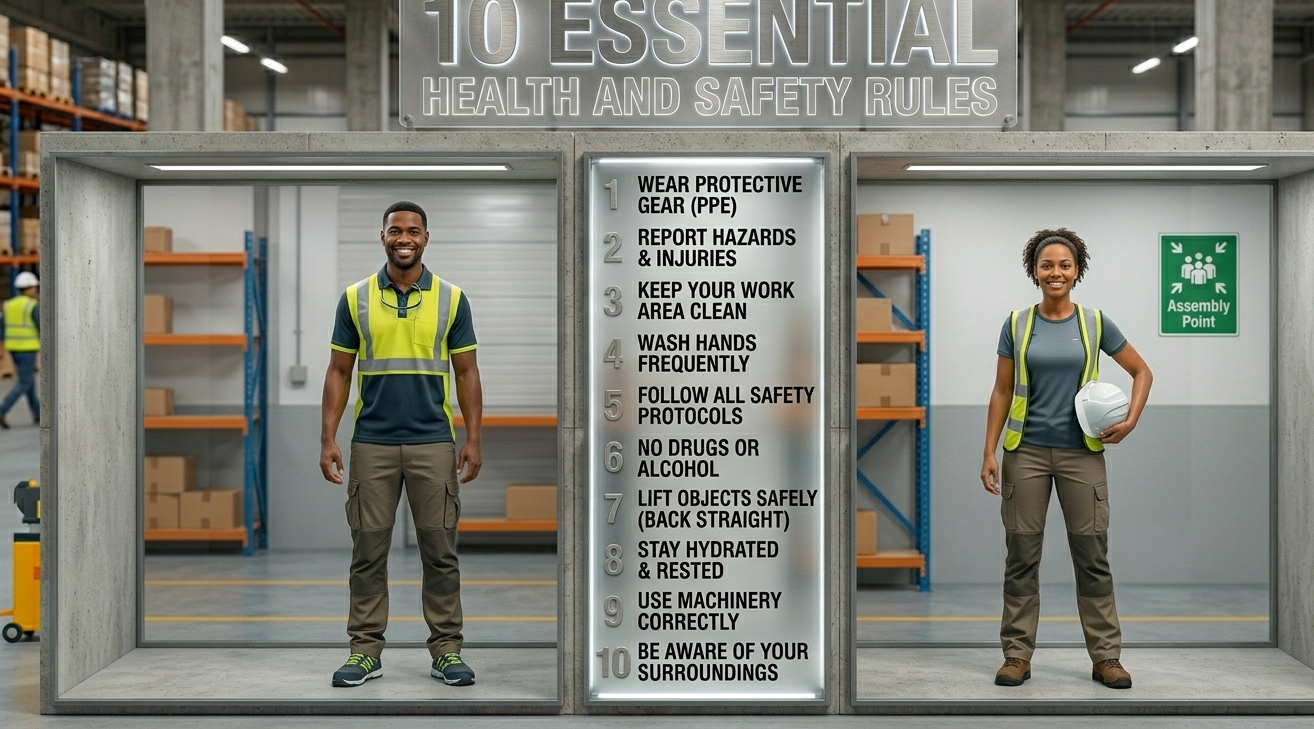
10 Health and Safety Rules Every UK Workplace Needs to Follow
Health & Safety18 May 202610 min read🇬🇧 UK Workplace Guide
Key Takeaways
- The 10 health and safety rules apply in every workplace — kitchens, workshops, offices, and beyond
- UK law under the Health and Safety at Work Act 1974 places a duty of care on both employers AND employees
- Risk assessment is the foundation of everything — without it, no other rule works properly
- Environment-specific rules (kitchen vs workshop) matter just as much as universal ones
- The HSE (Health and Safety Executive) is your official source for regulations — free to access at hse.gov.uk
Let’s be honest — when most people hear “10 health and safety rules“, their eyes glaze over. It sounds like a corporate compliance exercise, something ticked off during an induction day and promptly forgotten. But here’s what I’ve come to understand after years of seeing workplaces get this both right and catastrophically wrong: health and safety rules aren’t bureaucracy for bureaucracy’s sake. They’re the difference between going home in one piece and not going home at all.
Every year in the UK, the Health and Safety Executive (HSE) publishes statistics that should stop us in our tracks. In 2024/25, there were over 560,000 non-fatal injuries reported in workplaces across Britain, and 138 workers lost their lives. Behind every one of those numbers is a person, a family, and — in most cases — a preventable situation.
This guide covers the 10 health and safety rules that every UK workplace genuinely needs to follow, with specific guidance for kitchens, workshops, and general environments. Whether you’re an employer building a safety culture from scratch, a manager refreshing your team’s knowledge, or an employee who just wants to understand their rights and responsibilities — this is the plain-English guide you’ve been looking for.
10 Health and Safety Rules: The Universal Foundations
Before we get environment-specific, these ten rules form the backbone of safe working in any UK setting. They apply whether you’re running a commercial kitchen, a manufacturing workshop, a construction site, or an office.
Conduct regular risk assessments
Every workplace must identify hazards, evaluate risks, and put control measures in place. Under UK law, if you employ five or more people, this must be documented in writing. Risk assessment isn’t a one-off exercise — it should be reviewed whenever processes, equipment, or personnel change.
Provide and use appropriate PPE
Personal protective equipment must be provided free of charge by employers and worn correctly by employees. The right PPE depends on the risk: hard hats on construction sites, gloves and goggles in workshops, non-slip footwear in kitchens. PPE is the last line of defence — not the first.
Keep emergency exits clear at all times
Blocked fire exits kill people. It sounds obvious, yet HSE inspectors find obstructed exits in workplaces every single week. Routes must be clearly marked, unobstructed, and wide enough for rapid evacuation. Test them regularly — a fire drill is not an inconvenience, it’s a rehearsal.
Report every hazard, incident, and near-miss
A near-miss is a warning the workplace ignored. Under RIDDOR (Reporting of Injuries, Diseases and Dangerous Occurrences Regulations), certain incidents must be reported to the HSE. But even smaller incidents should be logged internally — patterns of near-misses predict serious accidents with alarming accuracy.
Maintain good housekeeping
Slips, trips, and falls account for roughly a third of all workplace injuries in the UK. Cluttered walkways, wet floors, trailing cables, and poorly stored materials are all preventable. A tidy workplace isn’t about aesthetics — it’s an active safety measure.
Follow safe manual handling procedures
Manual handling injuries — particularly back injuries — are among the most common and most debilitating workplace conditions in the UK. Employees must be trained in correct lifting techniques, and employers must design work to minimise the need for heavy manual handling wherever possible.
Only use equipment you’re trained to use
Operating machinery or equipment without proper training isn’t bravado — it’s a legal liability and a genuine danger. Employers must ensure adequate training before anyone uses any piece of equipment, from a pallet truck to a band saw. If you’re unsure, ask. No one should ever feel pressured to use something they haven’t been trained on.
Take rest breaks and manage fatigue
Fatigue impairs judgement as significantly as alcohol. The Working Time Regulations 1998 entitle workers to a 20-minute rest break in any shift over six hours, plus at least 11 hours rest between working days. Enforcing these isn’t soft management — it’s accident prevention.
Participate fully in safety training
Training isn’t optional, and attending without engaging defeats the purpose. Employers must provide relevant, up-to-date training; employees must take it seriously. First aid, fire safety, manual handling, equipment operation — these courses exist because the knowledge genuinely saves lives.
Take responsibility for yourself and others
Section 7 of the Health and Safety at Work Act 1974 places a legal duty on every employee — not just employers — to take reasonable care for their own health and safety and that of anyone affected by their actions. Safety is not someone else’s job. It’s everyone’s job.
“The goal of health and safety isn’t paperwork. It’s making sure people go home in the same condition they arrived.”
10 Health and Safety Rules in the Kitchen
Commercial and domestic kitchens present a unique constellation of hazards: sharp blades, hot surfaces, wet floors, raw proteins, high-pressure equipment, and the relentless pace of a busy service. The 10 health and safety rules in the kitchen aren’t optional extras on top of general workplace rules — they’re non-negotiable in any food environment regulated by the Food Standards Agency and the HSE.
Here’s what kitchen health and safety looks like in practice:
| Rule | Why It Matters | Legal Basis |
|---|---|---|
| Wash hands frequently and correctly | Prevents cross-contamination and foodborne illness | Food Safety Act 1990 |
| Separate raw and cooked foods at all times | Eliminates bacterial cross-contamination risk | Food Hygiene Regulations 2006 |
| Maintain correct food storage temperatures | Cold chain compliance stops bacterial growth | FSA Temperature Control Guidance |
| Use knives safely — cut away from the body, keep blades sharp | Blunt knives cause more injuries than sharp ones | Manual Handling Regulations 1992 |
| Keep floors dry and use non-slip matting | Wet kitchen floors are a leading slip-and-fall hazard | Workplace (Health, Safety and Welfare) Regs 1992 |
| Wear appropriate PPE — aprons, non-slip shoes, oven gloves | Burns, scalds, and cuts are all preventable | PPE at Work Regulations 1992 |
| Label and declare allergens correctly | Allergen incidents can be fatal — Natasha’s Law (2021) mandates labelling | Natasha’s Law / EU FIC Regulation |
| Check equipment before every use | Faulty extractors, fryers, and appliances cause fires and injuries | PUWER Regulations 1998 |
| Ensure adequate ventilation | Carbon monoxide from gas appliances can be deadly in enclosed spaces | Gas Safety Regulations 1998 |
| Maintain rigorous cleaning schedules | HACCP compliance requires documented cleaning — and protects customers | Food Hygiene Regulations 2006 |
10 Health and Safety Rules in a Workshop
Workshops — whether that’s a carpentry shop, a metal fabrication unit, a school DT room, or a home garage — sit at the riskier end of the workplace spectrum. You’ve got rotating machinery, cutting tools, electrical equipment, airborne particles, chemical substances, and often a time-pressured environment where shortcuts feel tempting. They shouldn’t be.
The 10 health and safety rules in a workshop that I’d put up on every noticeboard:
1. Never operate machinery without full training and authorisation
This is the golden rule of any workshop. Band saws, lathes, angle grinders, drill presses — every one of them can cause catastrophic injury in seconds. Manufacturers’ instructions matter. HSE approved codes of practice matter. Feeling confident is not the same as being trained.
2. Always wear the correct PPE for the task
Eye protection when grinding or cutting. Hearing protection near loud machinery. Dust masks when sanding. Gloves appropriate to the material — though never gloves near rotating machinery, which can drag your hand in. Understanding when to wear PPE is as important as having it.
3. Inspect tools and machinery before every use
A cracked grinding disc, a frayed power cable, a loose blade guard — each can cause serious injury without warning. Under PUWER (Provision and Use of Work Equipment Regulations 1998), equipment must be maintained in a safe condition. Pre-use checks are your first line of defence.
4. Isolate machinery before any maintenance or adjustment
Lockout/tagout procedures exist for one reason: to prevent machinery from being started while someone’s hands are inside it. This sounds extreme until you see the statistics. Always de-energise, isolate, and verify before reaching in.
5. Keep the workspace clear of clutter and debris
Wood shavings, metal swarf, off-cuts, and discarded materials accumulate quickly in active workshops. They’re trip hazards, fire risks, and can interfere with machinery operation. Build tidying into the workflow, not just the end of the day.
6. Store chemicals and hazardous substances correctly
COSHH (Control of Substances Hazardous to Health) Regulations require employers to assess and control exposure to hazardous substances. Solvents, adhesives, cutting fluids, and wood preservatives all have specific storage, handling, and disposal requirements. Data sheets must be accessible to everyone who uses them.
7. Ensure adequate lighting throughout
Poor lighting is a direct cause of accidents in workshops — misjudged cuts, missed hazards, and eyestrain errors. Natural light is ideal; where that’s insufficient, task lighting must be provided at workstations. The Workplace Regulations 1992 specify that lighting must be “suitable and sufficient.”
8. Never work alone with dangerous machinery
Lone working with significant machinery — particularly in out-of-hours situations — dramatically increases risk. If an accident occurs and you’re alone, the outcome depends entirely on whether help arrives. Lone worker policies should explicitly address this scenario.
9. Keep a stocked, accessible first aid kit
The Health and Safety (First Aid) Regulations 1981 require employers to provide adequate first aid equipment and personnel. In a workshop environment, burns, cuts, and eye injuries are foreseeable — your first aid provision should reflect that reality, not a minimum compliance tick-box.
10. Report damaged or faulty equipment immediately — and take it out of service
A damaged tool left in service is a trap waiting to be triggered. If you spot something wrong, tag it out, report it, and don’t use it until it’s been inspected and repaired by a competent person. Raising the issue is never an inconvenience — it’s potentially saving someone’s fingers.
10 Health and Safety Rules: The Golden Rules That Apply Everywhere
Beyond environment-specific guidance, there’s a set of principles — often called the “golden rules” of health and safety — that transcend industry and setting. These are the non-negotiables. The rules you hold firm on even under pressure, even when you’re busy, even when someone senior is pushing back.
They are, in plain English:
- Never bypass, disable, or override safety systems
- Always use the correct PPE for the task — every time, not just when someone’s watching
- Report every incident, injury, and near-miss — even minor ones
- Never work under the influence of alcohol, drugs, or any substance that impairs judgement
- Keep emergency routes, exits, and equipment clear and accessible at all times
- Follow risk assessments — they’re not optional guidance, they’re the plan
- Communicate hazards clearly and promptly to colleagues and management
- Participate actively in all mandatory safety training
- Maintain good housekeeping as an ongoing habit, not a weekly event
- Take responsibility for your own safety and actively look out for others
What Are the Fundamental Health and Safety Rules Under UK Law?
Everything in this guide ultimately flows back to one piece of legislation: the Health and Safety at Work Act 1974. It’s over 50 years old, but it remains the cornerstone of UK workplace safety law — and it’s worth understanding what it actually says, not just that it exists.
The Act places a duty of care on employers to ensure, so far as is reasonably practicable, the health, safety, and welfare of all employees. That phrase — “so far as is reasonably practicable” — is important. It means employers must balance the cost and effort of precautions against the level of risk. It does not mean safety measures are optional when they’re inconvenient.
Employees, meanwhile, have a duty under Section 7 to take reasonable care for their own safety and the safety of others, and to cooperate with their employer’s safety measures. You can’t simply opt out of health and safety obligations because you personally feel comfortable with a risk.
For everything else — from COSHH to RIDDOR, from the Working Time Regulations to the Management of Health and Safety at Work Regulations 1999 — the HSE’s official website is the authoritative, free reference point. If you’re building a safety management system, starting a new business, or just trying to understand your obligations, that’s where you go.
For complementary reading on building safer, more productive working environments, Insiders Profit Club covers practical strategies for UK businesses and professionals — including operational risk management, team culture, and sustainable growth practices that sit alongside formal compliance.
Where to Find Official Guidelines on the 10 Health and Safety Rules
One of the most common questions people ask — particularly managers and business owners — is where to find reliable, up-to-date official guidance. The internet is full of outdated PDFs and oversimplified checklists. Here’s where to go for the real thing:
HSE (Health and Safety Executive): hse.gov.uk is the primary regulatory body. Covers all industries, all regulations, and provides free downloadable guidance, industry-specific codes of practice, and statistics.
Food Standards Agency: For kitchen-specific food hygiene regulations and allergen guidance — food.gov.uk.
IOSH (Institution of Occupational Safety and Health): The professional body for H&S practitioners. Their Working Safely and Managing Safely courses are widely recognised and worth looking into for team training.
NEBOSH: For more in-depth qualifications, the National Examination Board in Occupational Safety and Health offers certifications from introductory to diploma level — suitable for managers who want formal H&S credentials.
Frequently Asked Questions
What are the 10 health and safety rules in the workplace?
The 10 core rules are: conduct regular risk assessments, provide and use proper PPE, keep emergency exits clear, report all incidents and near-misses, maintain good housekeeping, follow manual handling guidelines, only use equipment you’re trained on, take required rest breaks, participate in safety training, and take personal responsibility for your own and others’ safety.
What are the 10 health and safety rules in the kitchen?
Kitchen-specific rules include washing hands frequently, separating raw and cooked foods, maintaining correct storage temperatures, using knives safely, keeping floors dry, wearing appropriate PPE, declaring allergens correctly under Natasha’s Law, checking equipment before use, ensuring adequate ventilation, and following documented cleaning schedules.
What are the 10 health and safety rules in a workshop?
Workshop rules include: never operating machinery without training, wearing correct PPE, inspecting tools before use, isolating machinery before maintenance, keeping the workspace clear, storing chemicals correctly under COSHH, ensuring adequate lighting, never working alone with dangerous equipment, keeping a stocked first aid kit, and taking faulty equipment out of service immediately.
What are the 10 golden rules of health and safety?
The golden rules are: never bypass safety systems, always use correct PPE, report every incident, never work impaired, keep emergency routes clear, follow risk assessments, communicate hazards, participate in training, maintain good housekeeping, and take responsibility for yourself and others.
What are the fundamental health and safety rules under UK law?
The Health and Safety at Work Act 1974 is the foundation. It places a duty of care on employers to protect workers “so far as is reasonably practicable,” and on employees to take reasonable care for themselves and others. Supporting regulations include COSHH, RIDDOR, PUWER, and the Working Time Regulations.
Where can I find official guidelines on health and safety rules?
The HSE (Health and Safety Executive) at hse.gov.uk is the definitive official source for all UK workplace health and safety regulations. The Food Standards Agency at food.gov.uk covers kitchen and food business specific requirements.
The Bottom Line
The 10 health and safety rules we’ve covered aren’t arbitrary corporate policy. They’re the distilled result of decades of workplace incidents, legal development, and a genuine national commitment to bringing people home safe. Whether you’re running a busy restaurant kitchen, managing a production workshop, or simply trying to understand your responsibilities as an employee — these rules exist to protect you.
The honest truth is that most serious workplace accidents are preventable. Not in hindsight, but at the time — with the right risk assessment, the right training, and the right culture of actually taking safety seriously rather than treating it as a box to tick.
Start with the rule that feels most relevant to your environment. Conduct that risk assessment. Put up that emergency exit sign. Run that fire drill that’s been postponed three times. Health and safety doesn’t have to be complex to be effective — it just has to be done.
Looking for More Practical Workplace Guidance?
Insiders Profit Club publishes no-nonsense guides for UK businesses and professionals — covering everything from operational compliance to building high-performing teams. Real advice, built for the real world.
Visit Insiders Profit Club →