
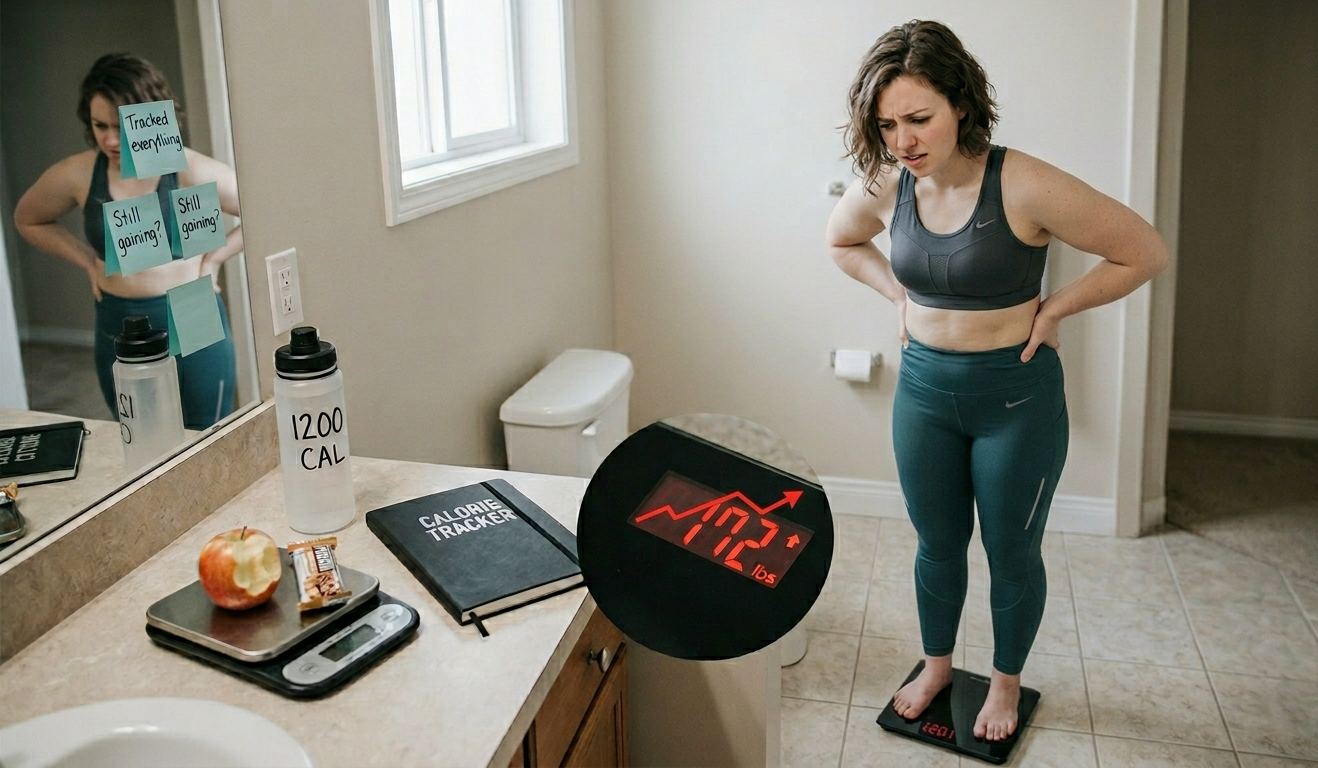
Gaining Weight on a Calorie Deficit? Hormones Are to Blame” Best guide
If you’re gaining weight on a calorie deficit, you’re not imagining things — and you’re definitely not alone. For women, the scale can stubbornly climb even when you’re eating less, tracking every bite, and doing everything “right.” The reason isn’t a lack of discipline; it’s your hormones. Cortisol spikes, estrogen fluctuations, thyroid function, and your menstrual cycle can all cause real, measurable weight changes that have nothing to do with fat gain. Understanding what’s actually happening in your body is the first step to stopping the frustration and finally making peace with the process.
✦ Key Takeaways
- Gaining weight on a calorie deficit is extremely common in women — and usually hormonal, not mathematical
- Cortisol, estrogen, and thyroid hormones can lead to substantial water retention, making it appear like you’ve gained fat./li>
- Eating too little can trigger your body’s stress response and actually stall fat loss
- Muscle glycogen loading, cycle phases, and sleep all affect the number on your scale
You’ve been doing everything right. You downloaded the app, you’re logging every meal, you’re eating in a gaining weight on a calorie deficit situation that makes absolutely zero sense on paper — and yet, somehow, the number on the scale went up this week. Again. If that sounds like you right now, know that there’s a real physiological reason this happens — and you’re not alone in experiencing it. — especially in women’s bodies.
This isn’t a willpower problem. It’s not a math problem. It’s a hormones and biology problem. And once you understand what’s actually going on underneath the surface, it changes everything about how you approach your health journey.
Why Gaining Weight on a Calorie Deficit Happens More Than You Think
Here’s something that most calorie-counting apps conveniently leave out: the human body — and specifically, the female body — is not a simple calculator. It’s a complex, adaptive system that responds to stress, hormones, sleep, and environment in ways that can absolutely override a basic energy equation.
The frustrating truth is that research consistently shows that women’s metabolic responses to caloric restriction differ significantly from men’s — largely because of the hormonal fluctuations built into our monthly cycle. When researchers study weight loss, they often use predominantly male subjects, and then we’re all supposed to apply those results to our very different biology. No wonder we feel broken when their rules don’t work for us.
You are not failing your diet. In many cases, your diet is failing to account for what your body is actually doing.
The Cortisol Connection: When Stress Makes You Hold Weight on a Calorie Deficit
Let’s talk about cortisol — the stress hormone that nobody warns you about when you start a diet. When you drastically cut calories, your body interprets that restriction as a survival threat. In response, your adrenal glands pump out more cortisol. And here’s where it gets interesting: elevated cortisol triggers water retention, particularly around the midsection, because it signals your kidneys to hold onto sodium and fluid.
So you’re eating less, your cortisol spikes from the restriction, and suddenly your body is holding an extra pound or two of water. The scale goes up. You panic, restrict more. Cortisol spikes again. It’s a cycle that can go on for weeks — and it looks exactly like your diet “not working.”
Women are also particularly sensitive to cortisol’s effects because estrogen and cortisol have a complex, intertwined relationship. When one fluctuates, the other often does too. This isn’t a flaw in your design — it’s an ancient protective mechanism. Your body genuinely cannot tell the difference between “I’m on a diet” and “food is scarce, we need to survive.”
Your Menstrual Cycle Is Secretly Running Your Scale Numbers
This one is a game-changer that I wish every woman knew before she ever started tracking her weight. Over the course of a 28-day cycle, women can naturally fluctuate anywhere from 2 to 10 pounds — purely from hormonal water retention, not fat. Here’s the rough breakdown:
Follicular phase (Days 1–13): Estrogen rises, water retention is relatively low — this is often when the scale looks best.
Ovulation (around Day 14): A small LH surge can cause a brief uptick in weight.
Luteal phase (Days 15–28): Progesterone rises, then drops. This phase brings bloating, fluid retention, and increased appetite — weight can climb noticeably even if you haven’t eaten more.
Menstruation: The scale may temporarily spike again before dropping as inflammation resolves.
If you step on the scale during your late luteal phase while you’re also in a calorie deficit, you might genuinely see a higher number than the week before — even though you’ve lost actual body fat. This is one of the most common reasons women give up on their nutrition plan, convinced it “isn’t working,” when physiologically, it absolutely is.
Thyroid Function: The Silent Factor in Women’s Weight Gain on a Calorie Deficit
Women are five to eight times more likely than men to have thyroid issues — and subclinical hypothyroidism (where levels are “borderline” but not flagged as a clinical problem) is notoriously underdiagnosed. Your thyroid controls your basal metabolic rate. When your metabolism slows down, even a real calorie deficit may not lead to the weight loss you expect, because your body burns fewer calories at rest than most standard calculators estimate..
If you’ve been eating in a deficit for several weeks with no meaningful change, it’s genuinely worth asking your doctor for a full thyroid panel — not just TSH, but Free T3, Free T4, and thyroid antibodies. This isn’t alarmist; it’s smart, informed advocacy for your own health.
New Exercise, Muscle Glycogen, and Why the Scale Lies After Workouts
Did you recently start or intensify your exercise routine alongside your calorie deficit? Here’s something your fitness app definitely didn’t tell you: when you begin strength training or increase your workout intensity, your muscles start storing more glycogen (stored carbohydrate) as fuel. Every gram of glycogen is stored alongside roughly 3 grams of water in your muscle tissue.
The result? Your muscles can temporarily hold several extra pounds of water-glycogen in the first two to four weeks of a new training program. This is actually a sign that your body is responding well to exercise and becoming more efficient — but it looks exactly like weight gain on the scale. Combine this with hormonal fluctuations and caloric restriction, and you have a perfect storm for a confusing number.
The scale measures your relationship with gravity. It does not measure your fat loss, your strength, or your progress.
What to Actually Do When You’re Gaining Weight on a Calorie Deficit
Okay — understanding the “why” is empowering, but let’s talk practical strategy. Here’s what genuinely helps:
Track weekly averages, not daily numbers. Weigh yourself daily if you want, but record only your 7-day average. Daily noise disappears when you zoom out, and real trends become visible. Apps like Happy Scale do this automatically and make the data much less emotionally charged.
Use body measurements and progress photos. Your waist, hips, and how your clothes fit are often more accurate short-term indicators of fat loss than the scale, especially during hormonal fluctuation periods.
Make sure your deficit isn’t too aggressive. A deficit of more than 500–700 calories per day can actually backfire for women by triggering cortisol elevation, adaptive thermogenesis (where your metabolism downregulates), and increased muscle loss. Slower and steadier genuinely does work better for female physiology over the long term.
Prioritize sleep. One night of poor sleep measurably increases ghrelin (the hunger hormone) and cortisol the next day — undermining both your appetite control and your water balance. Sleep is not optional if you’re trying to change your body composition.
Consider cycle syncing your expectations. Know where you are in your cycle and adjust your self-assessment accordingly. Don’t judge your progress in week three of your cycle; judge it in week one to two, when hormonal water retention is lowest and your data is cleanest.
The Bottom Line: Your Body Is Not Broken
If you’re experiencing gaining weight on a calorie deficit, I want you to hear this clearly: you are not doing it wrong, and you are not broken. Your body is responding to a complex web of hormonal signals that are entirely normal, entirely female, and entirely misunderstood by most mainstream diet advice that was never designed with women in mind.
The science is on your side. Cortisol, estrogen fluctuations, thyroid function, glycogen storage — these are all real, documented, physiological reasons why the scale can go up even when you’re genuinely eating less. The most powerful thing you can do is become curious instead of critical, zoom out instead of spiraling, and treat your body like the intelligent, adaptive system it actually is.
Progress isn’t always linear. But that doesn’t mean it isn’t happening.
Has This Happened to You?
Drop your experience in the comments below — how long did it take you to realize the scale wasn’t telling the full story? Your story might be exactly what someone else needs to read today.
Share Your Experience →