
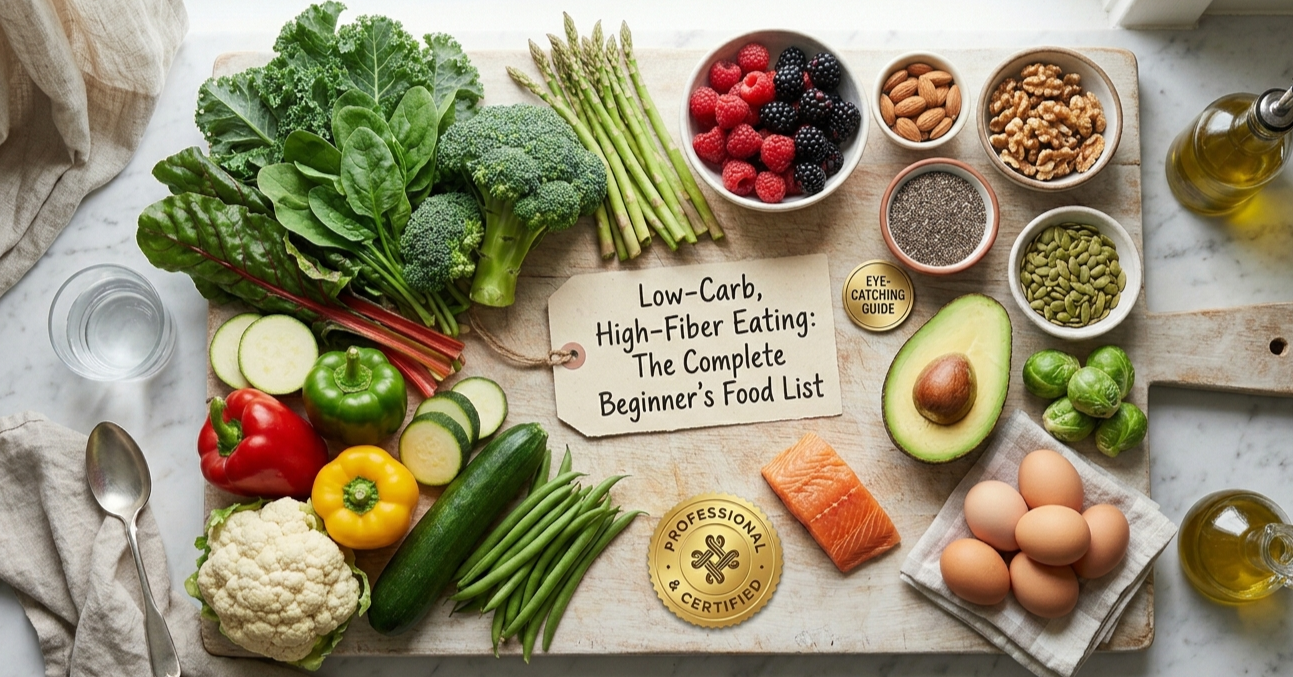
Low-Carb High-Fiber Foods: Transform Your Energy Fast
Most people assume that going low-carb means giving up fiber — and that assumption quietly derails more diets than almost anything else. The truth is, you can eat high in fiber and low in carbs at the same time, and doing both together is one of the smartest nutritional moves a health-conscious adult can make. This guide breaks down exactly which foods to eat, how much fiber you actually need, and the practical steps to make this way of eating work from day one — no guesswork, no conflicting advice, just clear and evidence-backed guidance.
📋 Key Takeaways
- You can absolutely eat high-fiber foods on a low-carb diet — the key is focusing on net carbs, not total carbs.
- Non-starchy vegetables, seeds, nuts, and avocados are your highest-value foods: loaded with fiber, light on digestible carbs.
- Most adults need 25–38g of fiber per day — a goal the majority of people consistently fall short of.
- Fiber from whole food is always preferable to supplements, but supplements can help fill gaps during dietary transitions.
- Common mistakes include cutting out all fruits and legumes too aggressively — there is nuance worth understanding.
Here is a question I hear all the time: “If I’m cutting carbs, doesn’t that mean I’m also cutting fiber?” It’s a fair concern — and one worth addressing head-on, because the answer is more nuanced than a simple yes or no. If you’ve been researching healthy high-carb foods, you may already know that not all carbs are created equal — and that logic applies here too.
The short answer: no, you do not have to sacrifice fiber to eat low-carb. In fact, with the right food choices, you can exceed your daily fiber targets while keeping carbohydrates well within a low-carb range. The two goals are far more compatible than most people realize.
This guide is designed for health-conscious adults who are new to the idea of combining low-carb eating with high-fiber intake. We’ll walk through the science, the food lists, the practical strategies, and the common traps to avoid — all grounded in evidence rather than trends.
Why Both Matter: The Case for Low-Carb and High-Fiber Together
Before we dive into food lists, it’s worth understanding why this combination is worth pursuing in the first place. Both dietary strategies have strong, independent evidence bases — and they happen to complement each other remarkably well.
The low-carb advantage
Reducing refined carbohydrates and added sugars is consistently associated with better blood sugar regulation, reduced triglycerides, improved HDL cholesterol, and meaningful weight loss — particularly in the first six to twelve months of adoption. For people managing type 2 diabetes, insulin resistance, or metabolic syndrome, lowering carbohydrate intake can be genuinely therapeutic.
The fiber advantage
Dietary fiber supports gut microbiome diversity, slows glucose absorption, reduces LDL cholesterol, promotes satiety, and is associated with lower all-cause mortality in large epidemiological studies. Despite its importance, the average adult in most Western countries consumes only about 15–17 grams of fiber per day — roughly half the recommended amount.
Here is the critical distinction that unlocks everything: when you calculate net carbs (total carbohydrates minus fiber grams), fiber doesn’t count against your daily carb budget. That’s because soluble and insoluble fiber are not digested and absorbed the way starch and sugars are — they pass through the digestive tract largely intact, feeding gut bacteria rather than raising blood glucose.
Understanding Net Carbs: The Foundation of This Approach
This single concept makes low-carb, high-fiber eating possible. Let’s make it concrete with an example.
An avocado contains roughly 12 grams of total carbohydrates per fruit. That might sound significant on a low-carb diet. But of those 12 grams, approximately 10 grams are fiber. The net carb content — the number that actually matters for blood sugar and insulin response — is just 2 grams.
This is the number most low-carb diet frameworks (including keto) use to track daily intake. Fiber is not deducted in all countries — in the U.S. and U.K., fiber is included in total carbs on labels, so the subtraction is necessary. In some European countries, fiber is already listed separately.
Once you understand net carbs, an entire category of high-fiber foods — foods you may have been avoiding out of caution — becomes available to you.
The High-Fiber, Low-Carb Food List: What to Eat
Let’s get practical. Below are the food categories and specific foods that deliver meaningful fiber without significant digestible carbohydrates. All net carb values are approximate and based on standard serving sizes.
Non-Starchy Vegetables (Your Most Important Category)
These should form the backbone of your diet. They are low in net carbs, high in fiber, and dense with micronutrients. Eat them generously — there is rarely a reason to restrict them.
Seeds: Small but Extraordinarily Fiber-Dense
Seeds deserve special attention. Chia seeds and flaxseeds in particular are among the most fiber-concentrated foods you can eat — with net carb counts so low they are essentially negligible. Add them to yogurt, smoothies, salad dressings, or baked goods.
Nuts: Satisfying, Fiber-Rich, and Calorie-Dense
Nuts are an excellent snack and ingredient on a low-carb, high-fiber diet — with one important caveat: they are calorie-dense. Portion size matters. A small handful (roughly 28g / 1 oz) is the standard serving to track.
Avocado: The Undisputed Champion
If there is one single food that most perfectly embodies the low-carb, high-fiber ideal, it is the avocado. Rich in monounsaturated fats, generous in fiber, and almost negligible in net carbs, avocado is one of the rare foods that genuinely earns the label “superfood.” Eat it freely.
What About Fruit?
This is where many beginners become confused. The instinct on a low-carb diet is to eliminate all fruit — but that approach is often unnecessarily restrictive, and it costs you meaningful fiber and micronutrients. Some fruits are perfectly compatible with low-carb eating.
Berries — particularly raspberries and blackberries — have exceptionally high fiber-to-carb ratios. A half-cup of raspberries contains more fiber than many vegetables, with a net carb count low enough to fit comfortably within a daily low-carb budget. Bananas, grapes, and mangoes, by contrast, are high in sugar and low in fiber relative to their carb content — and are better limited or avoided.
How to Hit 30+ Grams of Fiber Per Day (Without Eating Grains)
One of the most common concerns new low-carb eaters have is: “If I’m not eating bread, oatmeal, or beans, how on earth do I get enough fiber?” It’s a legitimate question. Let’s answer it with a concrete example.
2 tablespoons chia seeds (8g fiber) + ½ cup raspberries (4g fiber) = 12g fiber before 9am. For more morning meal ideas, see our guide to 5 healthy breakfasts that work on a low-carb plan.
2 cups spinach/kale mix (2.5g) + ½ avocado (5g) + 2 tablespoons ground flaxseed (4g) = ~11.5g fiber.
28g / 1oz almonds = 3.5g fiber. Pair with a few stalks of celery for an additional gram.
2 cups broccoli (4.8g) = ~5g fiber. Roasting brings out natural sweetness and improves palatability.
Total: approximately 32–33 grams of fiber — comfortably above the 25–38g daily recommendation — with total net carbs well under 50 grams for the day. No grains required.
Common Mistakes Beginners Make (And How to Avoid Them)
Starting any new dietary approach comes with a learning curve. Here are the mistakes I see most frequently — and what to do instead.
Mistake 1: Cutting carbs so aggressively that fiber intake collapses
Going very low-carb (under 20g net carbs daily, as in strict ketogenic diets) can make adequate fiber intake genuinely challenging without deliberate planning. If your primary goal is health maintenance or weight management — rather than strict therapeutic ketosis — a moderate low-carb approach (50–100g net carbs) gives you more flexibility to include high-fiber foods comfortably.
Mistake 2: Ignoring digestive adjustment symptoms
When you increase fiber intake significantly, especially from a low baseline, digestive discomfort — bloating, gas, changes in bowel habits — is common and temporary. Increase fiber gradually over two to four weeks rather than overhauling your diet overnight. Drink plenty of water: fiber without adequate hydration can worsen constipation rather than relieve it.
Mistake 3: Relying on processed “low-carb” packaged foods
The market for low-carb packaged products has exploded — and many of these products are convenient but nutritionally hollow. “Low-carb” bars, wraps, and snack foods often contain minimal fiber, poor-quality ingredients, and ingredients that can trigger digestive distress in sensitive individuals. Whole foods are always the better foundation.
Mistake 4: Eliminating eggs in search of more fiber
Eggs come up often in online discussions about low-carb eating, with some people questioning whether they fit. They do — emphatically. Eggs contain essentially zero carbs and zero fiber, making them a neutral base protein. They are not a fiber source, but they are an excellent low-carb food to build fiber-rich meals around.
Mistake 5: Ignoring kidney health considerations
A high-protein, low-carb diet — particularly one heavy in animal proteins — can increase the metabolic load on the kidneys over time. This is a relevant consideration for anyone with existing kidney function concerns. Interestingly, a well-formulated low-carb diet that emphasizes plant-based proteins and is not excessively high in animal protein may actually be favorable for kidney health. If you have elevated creatinine levels or a history of kidney issues, this is a topic worth discussing specifically with your physician.
Practical Shopping List for Your First Week
To make this easier to act on immediately, here is a simple, first-week shopping framework built entirely around low-carb, high-fiber eating. Pair this with our deep dive into nutrient-rich foods to understand exactly why these choices matter beyond just fiber and carbs.
A Note on Fiber Supplements
Supplements like psyllium husk powder, inulin, and acacia fiber are commonly used to fill fiber gaps — and they can be a useful bridge while you are building new food habits. However, they are not equivalent to dietary fiber from whole foods.
Whole food fiber comes packaged with vitamins, minerals, antioxidants, and phytonutrients that no supplement can replicate. Use supplements strategically if you genuinely cannot meet your fiber needs through food alone — but do not use them as a substitute for dietary improvement.
The Bottom Line
Low-carb eating and high-fiber eating are not opposing strategies. When approached thoughtfully, they are deeply compatible — and together, they address two of the most common nutritional gaps in modern diets simultaneously.
The key is shifting your attention away from total carbohydrates and toward net carbs, and building your diet around the foods that deliver the most fiber per gram of digestible carbohydrate. Non-starchy vegetables, seeds, nuts, avocados, and low-sugar berries are your cornerstones.
Start simply. Add a tablespoon of chia seeds to your morning routine this week. Swap your afternoon snack for a handful of almonds and a cup of raspberries. Add a roasted vegetable to dinner every night. These are not dramatic overhauls — they are the kinds of consistent, sustainable changes that actually translate into better health outcomes over time.
You do not need to be perfect. You need to be consistent, curious, and willing to learn what works for your body.
Have Questions About Your Specific Situation?
Every person’s dietary needs are different. What works well for one person may need adjustment for another — and that’s completely normal.
Drop your questions in the comments below. What’s the most challenging part of eating high-fiber on a low-carb diet for you? I read every comment and do my best to respond to each one with specific, practical guidance.